
Wildlife bridge muscles ahead despite recent criticism
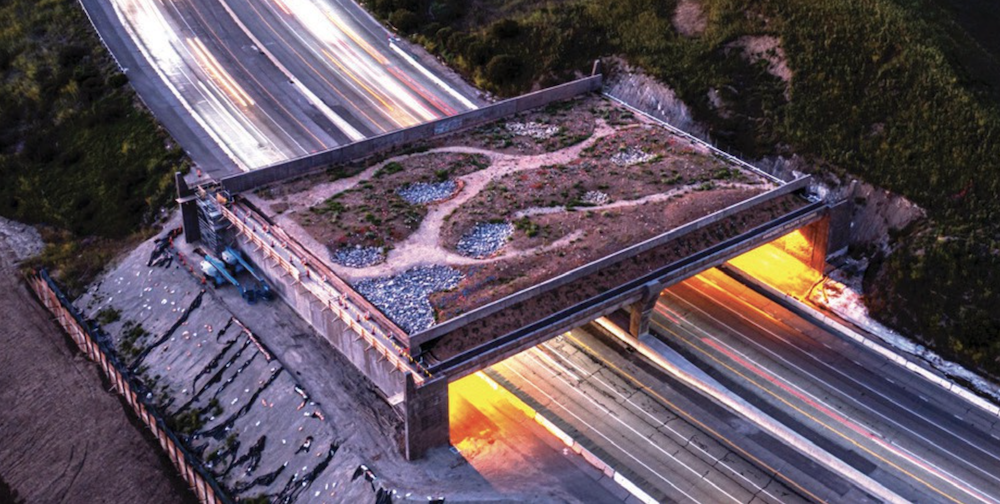
As supporters of the Wallis Annenberg Wildlife Crossing in Agoura Hills gear up for an Earth Day celebration atop the bridge over the 101 Freeway on April 22—exactly four years since the official groundbreaking—the project has come under fire for delays and cost overruns. Some of the crossing’s backers say the surge of criticism online shows signs of a manufactured outrage campaign.
The recent anti-bridge backlash was touched off by a March 18 opinion article in The California Post, the newly launched Los Angeles version of the conservative tabloid The New York Post. Headlined “California’s unfinished wildlife ‘bridge to nowhere’ tops $100M,” the story by Christopher F. Rufo and Kenneth Schrupp noted that the overpass, originally slated for completion in 2025, is now $21 million over budget.
“What was supposed to be the world’s largest wildlife crossing has become a jobs program for environmentalists, with taxpayers on the hook for what (crossing advocate) Beth Pratt told us is an overpass ‘for everything from monarch butterflies to mountain lions,’” the article stated.
Pratt, California regional executive director of the National Wildlife Federation and leader of the Save LA Cougars campaign, is the standard-bearer for the overpass, which is intended to allow mountain lions and other wildlife to safely traverse 10 lanes of L.A. freeway.
The article suggested that the goal of increasing genetic diversity among the isolated cougar populations of the Santa Monica Mountains and Simi Hills could have been achieved far more cheaply by introducing new animals into breeding groups. As for building more crossings, the authors concluded: “Californians can’t afford it.”
The paper’s editorial board then followed up, casting the crossing as the latest in a string of state infrastructure projects that run late or over budget—or fail entirely.
Social media amplified the criticism.
“Another in the long, outrageously expensive pet projects touted by (Gavin) Newsom but left undone, overbudget, and functionally useless in a state awash in red ink,” one person posted.
Record rainy seasons in 2022 and 2023 stymied soil compaction and concrete pouring work at the crossing site, pushing the anticipated completion date to late 2026 more than a year ago. Significant cost increases were reported in January, attributed by project managers to tariff-driven inflation.
Despite the absence of any new information, even a figure as prominent as L.A. developer and 2022 mayoral candidate Rick Caruso joined the virtual chorus of critics. “We have a wildlife bridge that’s uncompleted here in California,” Caruso said in a video posted to social media on March 20. “They’ve already sent $100 million and it’s still not done. I tell you, it’s crazy.”
Caruso—whose Southland properties include The Commons at Calabasas and The Promenade at Westlake—said he loves animals but believes elected officials should prioritize “helping people increase their quality of life” through investments in public safety, cleaner streets, better schools and more affordable housing.
Calling the cost of the crossing “a fortune,” the billionaire real estate mogul asserted, “We don’t have an income problem in the state of California or in the City of Los Angeles . . . we’ve got a spending problem.”
Smear campaign
A LinkedIn post by Daniel Villaseñor, deputy secretary of communications for the California Department of Natural Resources, reportedly describes the “recent anti-California narrative” as an example of “how coordinated outrage cycles are engineered.”
Villaseñor noted that the “provocative” California Post article first appeared in City Journal, a magazine published by the conservative think tank Manhattan Institute for Policy Research. After the story was picked up by the Rupert Murdoch-owned newspaper, “bite-sized snippets stripped of context” were circulated on social media by “MAGA-aligned influencers.”
Some suggested that the unfinished bridge, which has yet to be connected to the surrounding terrain, leads “nowhere”— including Transportation Secretary Sean Duffy, who wrote on Elon Musk’s X app, “Leave the building to us, @GavinNewsom.”
“Cable news closes the loop,” Villaseñor wrote. “Fox News runs coverage focused on the reaction rather than the underlying facts. At this point, the original accuracy of the story is irrelevant; the outrage cycle is complete.”
Villaseñor’s agency issued posts that said the said the Agoura Hills project shouldn’t be attacked for being an outlier.
“Just last year,” one post said, “California completed four wildlife crossings with an average price tag of $16 million—and 37 more are in progress across the state at an average cost of $15 million.”
This is the same price tag as an overpass in Colorado that’s been in the news, a bridge that is similar in size and scope to Agoura Hills but has been lauded for being far cheaper.
“The Annenberg Wildlife Crossing is the most ambitious project of its kind in the world, with a much larger scale,” the agency added. “It does not represent the average cost of our work to build more wildlife connectivity.”
“I can only speak to facts,” said Pratt, who gave an update on the project’s timeline and budget in January. “We presented the facts of the crossing online, there was nothing political about our approach. The facts are that construction project (costs) have gone through the roof, for everybody, not just our crossing.”
Comments are closed.